Abu Dhabi History
Abu Dhabi City Tour | Abu Dhabi Safari
 History
of Abu Dhabi dates back to 3rd millennium BC. Abu Dhabi's early history fits the
nomadic herding and fishing pattern typical of the broader region. Modern Abu
Dhabi traces its origins to the rise of an important tribal confederation, the
Bani Yas, in the late 18th century, which also subsequently assumed
control of the town of Dubai. In the 19th century the Dubai and Abu Dhabi
branches of the confederation parted ways.
History
of Abu Dhabi dates back to 3rd millennium BC. Abu Dhabi's early history fits the
nomadic herding and fishing pattern typical of the broader region. Modern Abu
Dhabi traces its origins to the rise of an important tribal confederation, the
Bani Yas, in the late 18th century, which also subsequently assumed
control of the town of Dubai. In the 19th century the Dubai and Abu Dhabi
branches of the confederation parted ways.
Into the mid-20th century, the economy of Abu Dhabi continued to be sustained mainly by camel herding, production of dates and vegetables at the inland oases of Al Ain and Liwa Oasis, and fishing and pearl diving off the coast of Abu Dhabi city, which was occupied mainly during the summer months. Most dwellings in Abu Dhabi city were, at this time constructed of palm fronds (barasti), with the wealthier families occupying mud huts. The growth of the cultured pearl industry in the first half of the twentieth century created hardship for residents of Abu Dhabi as pearls represented the largest export and main source of cash earnings.
In 1939, Sheikh Shakhbut Bin-Sultan Al Nahyan granted petroleum concessions, and oil was first found in 1958. At first, oil money had a marginal impact. A few low-rise concrete buildings were erected, and the first paved road was completed in 1961, but Sheikh Shakbut, uncertain whether the new oil royalties would last, took a cautious approach, preferring to save the revenue rather than investing it in development. His brother, Zayed bin Sultan Al Nahyan, saw that oil wealth had the potential to transform Abu Dhabi. The ruling Al Nahyan family decided that Sheikh Zayed should replace his brother as ruler and carry out his vision of developing the country. On August 6, 1966, with the assistance of the British, Sheikh Zayed became the new ruler.
With the announcement by the UK in 1968 that it would withdraw from the Gulf area by 1971, Sheikh Zayed became the main driving force behind the formation of the United Arab Emirates.
After the Emirates gained independence in 1971, oil wealth continued to flow to the area and traditional mud-brick huts were rapidly replaced with banks, boutiques and modern high rises.
Location
Satellite image of Abu Dhabi (March 2003)
Abu Dhabi seen from SPOT satelliteThe emirate of Abu Dhabi is located in the
oil-rich and strategic United Arab Emirates and is an active member of the Gulf
Co-operation Council (GCC). It borders with the Kingdom of Saudi Arabia (south)
and the Sultanate of Oman (east). The emirate borders the emirate of Dubai to
its northeast. In the north is the Persian Gulf.
Abu Dhabi city is on an island located less than a quarter-kilometer from the mainland and is joined to the mainland by the Maqta and Mussafah Bridges. A third bridge, designed by Zaha Hadid, is currently under construction. Bridges connecting to Reem Island and Saadiyat Island are also under construction.
Most of Abu Dhabi is located on the island itself, but it has many suburbs on the mainland for example: The Khalifa Cities, Between Two Bridges, Mussafah Residential and more.
Language and literature
The majority of the inhabitants of Abu Dhabi are expatriate workers from
India, Pakistan, Egypt, Bangladesh, Sri Lanka, Philippines, Britain, various
countries from across the Arab world and elsewhere. Consequently, English,
Tagalog, Tigrinya, Amharic, Bengali, and Urdu are widely spoken. Apart from
Hindi, the many Indian expatriates also contribute other South Asian languages
to the cultural milieu, including Malayalam, widely spoken in Kerala.
The native-born population are Arabic-speaking Gulf Arabs who are part of a
clan-based society. The Al Nahyan family, part of the al-Falah branch of the
Bani Yas clan, rules the emirate and has a central place in society.
Current ruler
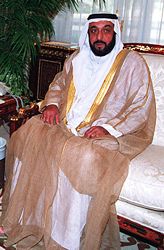 Sheikh
Khalifa bin Zayed Al Nahyan is the hereditary ruler of Abu Dhabi and president
of United Arab Emirates (UAE). He succeeded to the post on 3 November 2004,
replacing his father Zayed bin Sultan Al Nahyan, who had died the day before. He
had effectively been acting president earlier, since his father was in ill
health. He is the hereditary emir and ruler of Abu Dhabi.
Sheikh
Khalifa bin Zayed Al Nahyan is the hereditary ruler of Abu Dhabi and president
of United Arab Emirates (UAE). He succeeded to the post on 3 November 2004,
replacing his father Zayed bin Sultan Al Nahyan, who had died the day before. He
had effectively been acting president earlier, since his father was in ill
health. He is the hereditary emir and ruler of Abu Dhabi.
Following the establishment of the UAE on 2 December 1971, Sheikh Khalifa became deputy prime minister of the federal state under his father, who was president. In May 1976 he became deputy commander of the UAE armed forces. He also heads the Supreme Petroleum Council, which enjoys wide powers in energy matters.
Sheikh Khalifa is known for his interest in sports traditional to UAE, chiefly horse and camel racing. A building in the theology department at Lampeter is named after him, due to his being a benefactor. He is generally regarded as a pro-Western modernizer. Early in his term, in April 2005, he authorized a 15-25% salary increase for employees of the state.
On 1 December 2005 the President announced that half of the members of the Federal National Council, the closest body the country has to a parliament, will be indirectly elected. However half of the council's members will still need to be appointed by the leaders of the emirates. The 40-member FNC serves in an advisory capacity. The elections have been set to take place in December 2006.
Economy
Marina Mall.Abu Dhabi is the wealthiest emirate of the UAE in terms of Gross Domestic Product (GDP) and per capita income. The average net worth for Abu Dhabi's 420,000 citizens is AED 62 million (US$ 17 million), and more than $1 trillion is invested worldwide in this city alone. The Gross Domestic Product per capita also reached $63,000 [2], which is far above the average income of the United Arab Emirates and which ranks third in the world after Luxembourg and Norway. Abu Dhabi is also planning many future projects sharing with the GCC and taking 29% of all the GCC future plannings. The United Arab Emirates is a fast-growing economy: in 2006 the per capita income grew by 9%, providing a GDP per capita of $49,700 and ranking third in the world at PPP. Abu Dhabi plays a large role in the world economy. Abu Dhabi's sovereign wealth fund, the Abu Dhabi Investment Authority (ADIA), currently estimated at US$ 875 billion, is the world's wealthiest soverign fund, in terms of total asset value.
Climate
Sunny/blue skies can be expected throughout the year. The months of April through September are generally hot and humid with maximum temperatures averaging above 40 °C (104°F). During this time, sandstorms also occur intermittently, in some cases reducing visibility down to a few meters.
The weather is cooler from November to March. This period also sees dense fog on some days. The oasis city of Al Ain, about 150 km away, bordering Oman, regularly records the highest summer temperatures in the country, however the dry desert air and cooler evenings make it a traditional retreat from the intense summer heat and year round humidity of the capital city.
Transport
Interior of Abu Dhabi airport.Abu Dhabi International Airport (AUH) serves this city. The local time is GMT + 4 hours. Private vehicles and taxis are the primary means of transportation in the city. There is a 2 AED pick-up fee plus 0.50 AED per km. Public buses are available, but are not widely used. The fare starts at 2 AED and it is rare for the fare to go above 6 AED during intracity travel. There are bus routes to nearby towns such as Baniyas, Habashan and Al Ain, among others. A service to Dubai (about 160 km away) started in 2005
City planning
The city was planned in the 1970s for an estimated maximum population of 600,000. In accordance with what was considered to be ideal urban planning at the time, the city has wide grid-pattern roads, and high-density tower blocks.
On the northerly end of the island, where the population density is highest, the main streets are lined with 20-story towers. Inside this rectangle of towers is a normal grid pattern of roads with lower density buildings (2 story villas or 6 story low-rise buildings).
Abu Dhabi city is a modern city with broad boulevards, tall office and apartment buildings, and busy shops. Principal thoroughfares are The Corniche, Airport Road, Sheikh Zayed Street, Hamdan Street and Khalifa Street.
Abu Dhabi city is known in the region for its greenery; the former desert
strip today includes numerous parks and gardens. Mail is generally delivered to
post-office boxes only; however, there is door-to-door delivery for commercial
organizations. There are many parks (or public gardens) throughout the city.
Entrance is usually free for children, however there is often an entry fee for
adults. The city has a "Corniche," or seaside promenade, about 7 kilometres (4.3
mi) in length, with gardens, playgrounds, and a BMX/Skateboard ring.
The design of the inner city roads and main roads are quite organised. All
horizontal streets (starting from Corniche street, St. # 1) are odd and the
verticals are evenly numbered. So Corniche is Street #1, Khalifa is Street # 3,
Hamdan is Street # 5, and so on. While Salam Street is St # 8.[5]
Tours from Abu Dhabi:
Desert Safari: An experience that is must have in this fabulous city. Our team has experience drivers who will take yo to the sands of Arabia in a unique & thrilling way. Later you will have a BBQ dinner and be entertained by a belly dance. US$ 85.00 Per person runs daily. More details. Book Now.
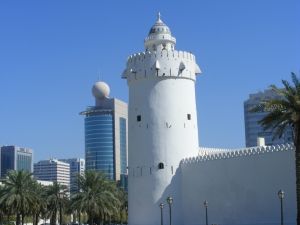
Abu Dhabi City tour: Visit the Sheikh Zayed mosque, Qasre Hosan fort the vegetable Souq and the corniche of Abu Dhabi. The tour gives you details of ABu Dhabi's history and modern facilities. US$ 45.00 Per person minimum 4 people required. Book Now.
Full Day Excursion to Dubai: Visit Dubai from Abu dhabi we will drive you to Dubai where you will have a tour of Dubai visiting the Dubai Museum, the Sheilkh zayed road the Burj Al Arab area and the gold souk. We will have lunch at an Arabian Restaurant in a traditional style later we will drive you back to Abu Dhabi. US$ 92.00 Per person minimum 4 people required Contact us Now for details
Abu Dhabi City Tour - Half Day)
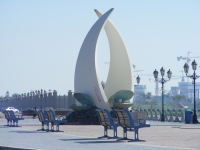
Visit Cornish road and breakwater, giving you an insight into the Manhattan of MiddleEast,
Petroleum Exhibition and Dhow yard, where traditional Arabian Dhows "boats" are
built even today with age old toots, continue to visit the Women's handicraft center and
finally, we stop at the Souk "traditional marker.
Contact us Now for
details
Al Ain City Tour - Half Day
As you drive towards Al Ain, the oasis of the Emirates, enjoy the golden sand dunes
rolling away into the horizon. Upon arrival visit Al Jahily fort,and the interesting Al
Ain museum, followed by a visit to the lively camel market. Will take you to the
neighboring oldest city of Al Buraimi, Sultanate of Oman. On our return journey your last
stop will be at the famous Hafeet Mountain.
Contact us Now for
details.
Liwa Oasis Safari - Full Day
Drive through majestic sand dunes, traditional Arabic villages and camels in the wild as
you drive across the Liwa oasis, part of the biggest sand of the world. Enjoy the wonders
and the tranquility of desert life.
Contact us Now for
details.
Falconry : One of the most popular traditional sports. Falconry is one of the ancient past times of Bedouins and used to be also one of the means of survival in the past. Contact us Now for details
Water Sports : Wind surfing, Jet Skiing, Sailing, Water Skiing, Paragliding ,
Pedal boats .....
Diving : Waters of Arabian Gulf offer considerable attractions and variety for
Scuba Divers and Snorkellers. The marine life in the Gulf is rich and colorful with
beautiful coral gardens, colorful fishes, ancient Wrecks And More .... Diving Courses,
Special Trainings or qualified instructors are arranged on request.
Contact us Now for
details.
Squash - Tennis - Badminton : Numerous courts are available throughout the city & Sports Clubs. Almost all Major hotels have floodlit tennis courts & Squash courts.
Hotels in Abu Dhabi.
- Abu Dhabi Grand.shtml
- Al Maha Rotana Suite
- Al Rawda Rotana Suit
- Beach Rotana Hotel T
- Crowne Plaza Abu Dha
- Crowne Plaza Hotel A
- Golden Tulip Dalma S
- Grand Continental Fl
- Grand Continental Fl
- Hilton Baynunah.shtml
- Hilton Corniche Resi
- Hilton Ras AL Khaima
- Hotel Inter-Continen
- Howard Johnson Hotel
- International Rotana
- Khalidia Palace Hote
- Le Meridien Abu Dhab
- Millennium Hotel Abu
- Sands Hotel.shtml
- Sheraton Abu Dhabi R
- Sheraton Residence A